
Operational Skill Training
Build Your Operational RV Team in 40 Weeks
Mentors: Jana Rogge | Caren Gallaudet | Estefany Carrillo
Our Vision:
We believe that there is a need—and also a clear path—to position remote viewing as a strategic tool for business and professional application, at the nexus of research, training, and client practice. In this vision, RV moves beyond reactive case-by-case work and develops into a structured, professional capability supported by standards, portfolio building, and repeatable team performance.
Operational remote viewing requires more than well-trained viewers. A functioning project team includes distinct roles—viewer, project manager, tasker, monitor, and analyst—each with specific responsibilities, skills, and standards of practice.
The purpose of Operational Skill Training is to help develop these roles within a structured team environment. It prepares participants to work with clear procedures, appropriate information boundaries, reliable communication, and realistic expectations. This way, an RV group becomes operationally competent without using real clients as its primary training ground.
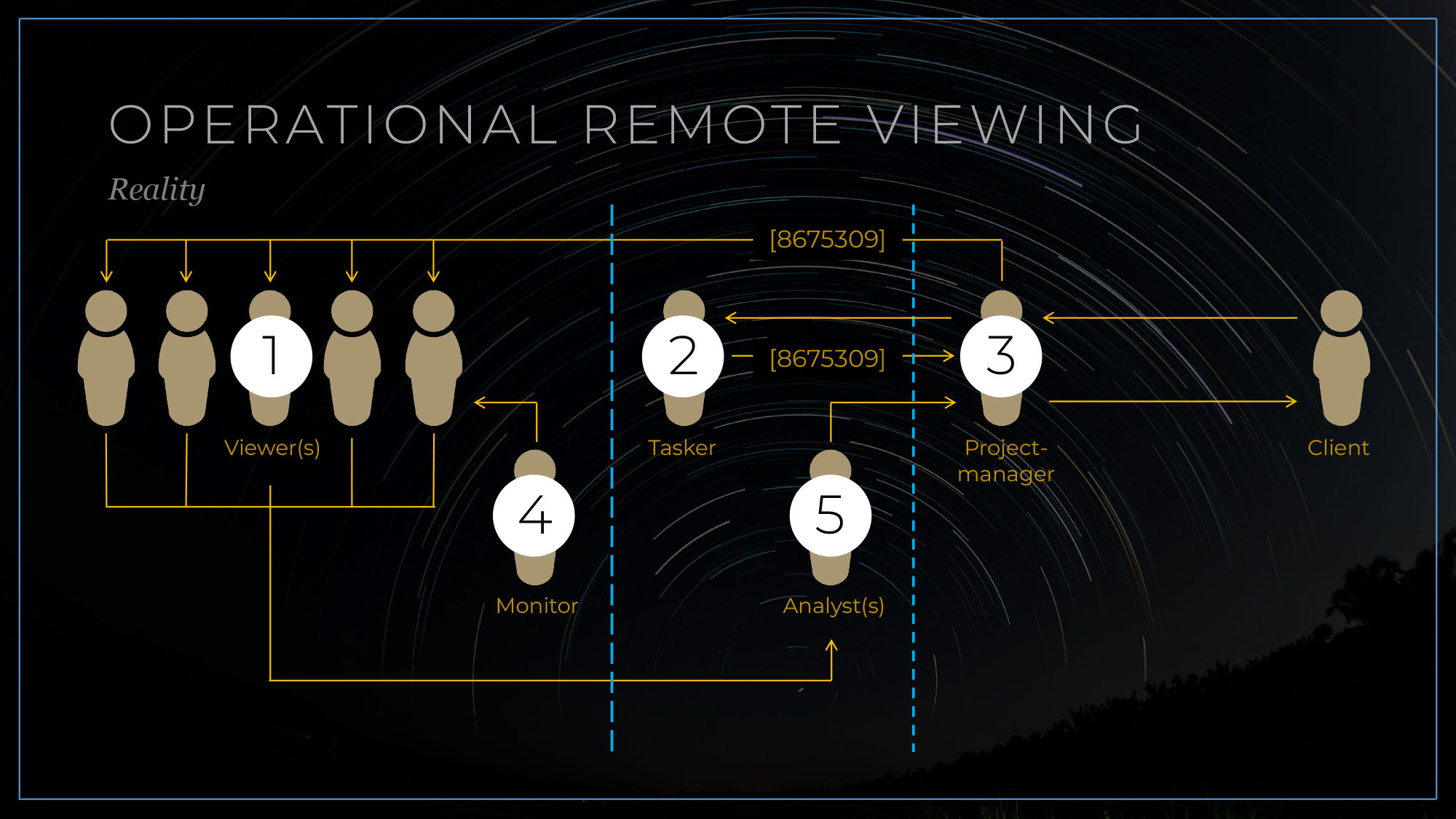
Different roles in an operational remote viewing team.
From Practice to Operations
Training and operational work are not the same. Training can use short practice sessions, full and rapid feedback, and a focused learning environment. Operational work involves uncertainty, responsibility, delayed or limited feedback, and the need to produce useful, well-documented deliverables.
The transition from individual practice to professional application therefore requires more than additional viewing sessions. It requires experience with processes, roles, quality control, project planning, communication, and accountability.
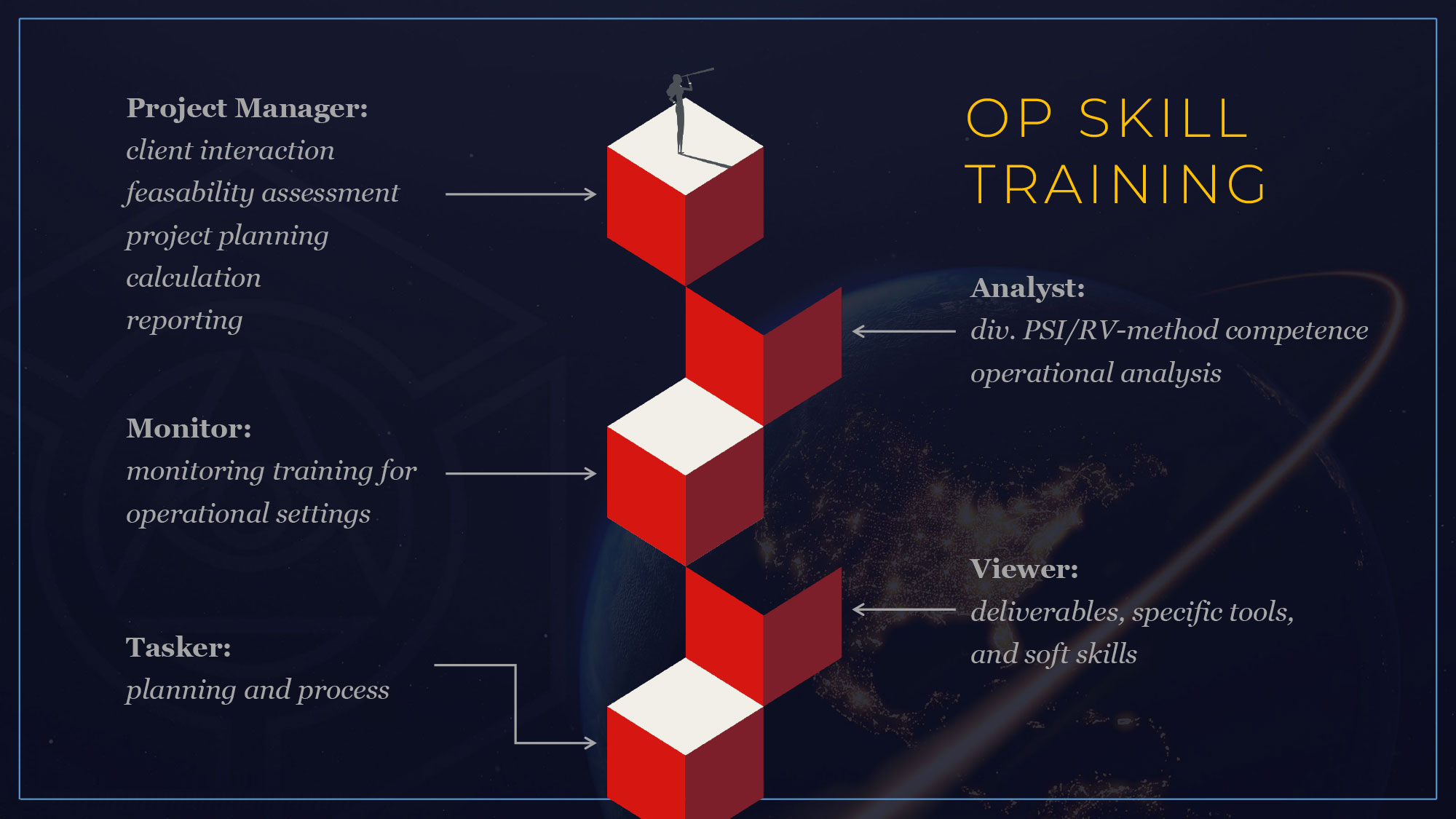
A Team-Based Approach
Operational Remote Viewing is a coordinated process. Depending on the project, the team may include several viewers, a monitor, a tasker, one or more analysts, and a project manager who serves as the primary point of contact with the client.
Each role contributes to the integrity and usefulness of the project:
- Viewers produce structured session data and learn to work within defined deliverable formats.
- Monitors support the viewing process and adapt monitoring skills to operational settings.
- Taskers translate the project objective into an appropriate tasking structure and manage the tasking process.
- Analysts assess and integrate data, applying appropriate Remote Viewing and analytical methods.
- Project managers assess feasibility, plan the project, coordinate client communication, manage budgets and timelines, and prepare reporting.
Our Training:
A credible operational process requires clear procedures. Blinding protocols, defined responsibilities, controlled information flow, documentation, and quality management help protect the working process from unnecessary influence, assumptions, and avoidable error.
Operational Skill Training focuses on building these practical capabilities. Participants learn not only how to work within their own role, but also how their work affects every other part of the project. The goal is building a team that can coordinate effectively, evaluate its own process, and communicate results responsibly.
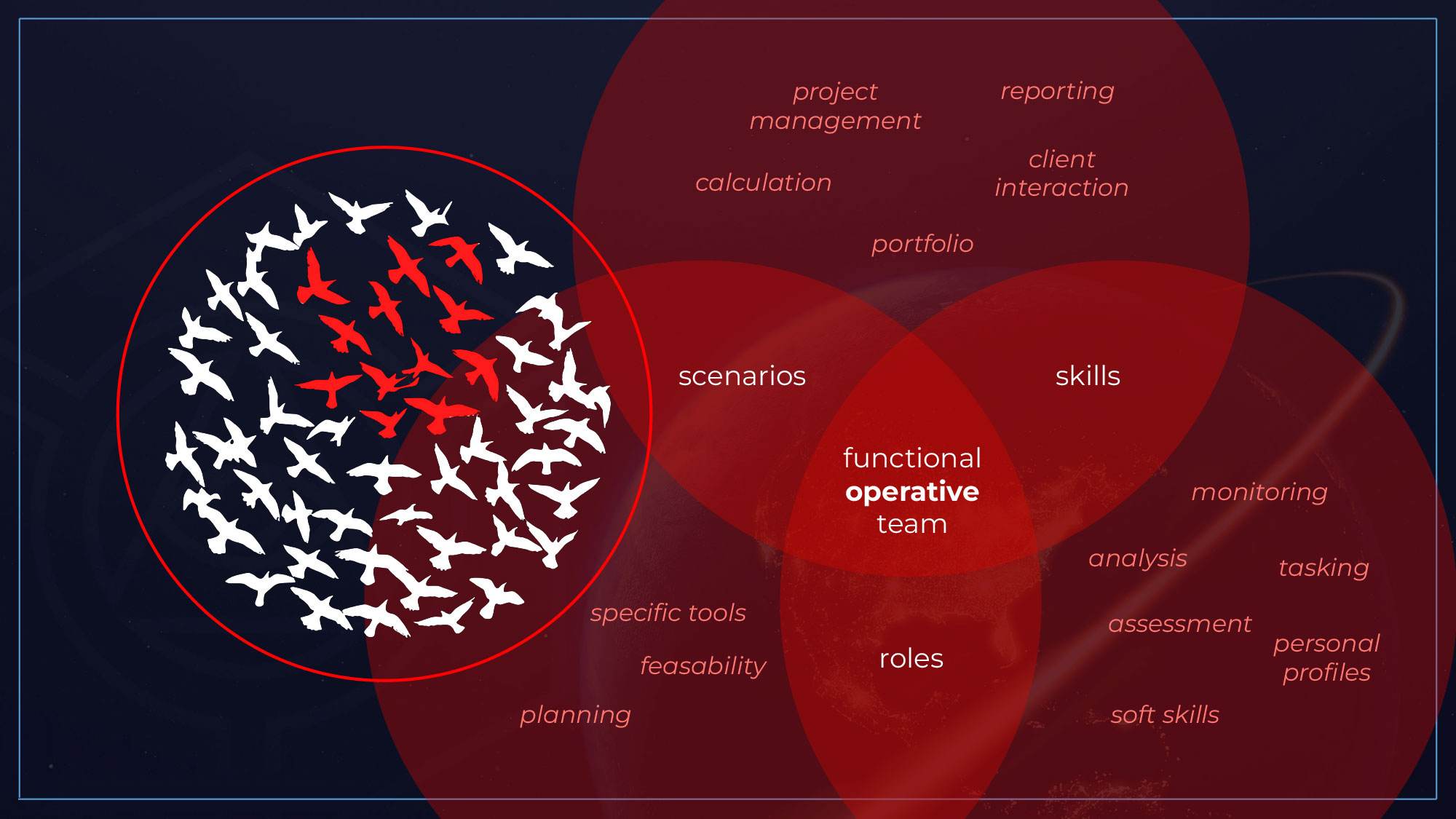
Over the period of one year, the team trains SKILLS, SCENARIOS, and ROLES for operational work.
Building Professional Capability
The program connects the learning environment of research and practice projects with the demands of real-world operations. This helps build the viewer’s “soft skills” such as reliability, discipline, communication, patience with feedback, and the ability to recognize both successes and misses. Operational training further adds role-specific tools, realistic project scenarios, and structured quality management. The aim is to develop teams that work with discipline and professional judgment: teams that can assess whether a project is appropriate, define a workable process, produce structured outputs, and communicate both findings and limitations clearly and with quality.
Prerequisites:
Prior training or experience with structured remote viewing protocols—such as CRV, TRV, SRV, or comparable methods—is required. Ideally, applicants should have reached at least an intermediate level (this means being able to develop abstract and conceptual information about a target, beyond the sensory and dimensional description of locations and objects). Experience with more than one remote viewing method, as well as experience in analysis or monitoring, is helpful but not required. These areas will be covered in depth during the training.
Participants must be able to attend the weekly Zoom meetings. A PDF scanning app is also recommended for capturing session material as black-and-white PDF files and sending it to the team. The group work will be organized on our Discord server (you will receive an invitation).
As preparation, we also recommend revisiting The Principles of Remote Viewing in some depth.
Session and working language will be English.
Your Mentors
WITH WHOM DO YOU TRAIN AND WHY?
Jana Rogge:
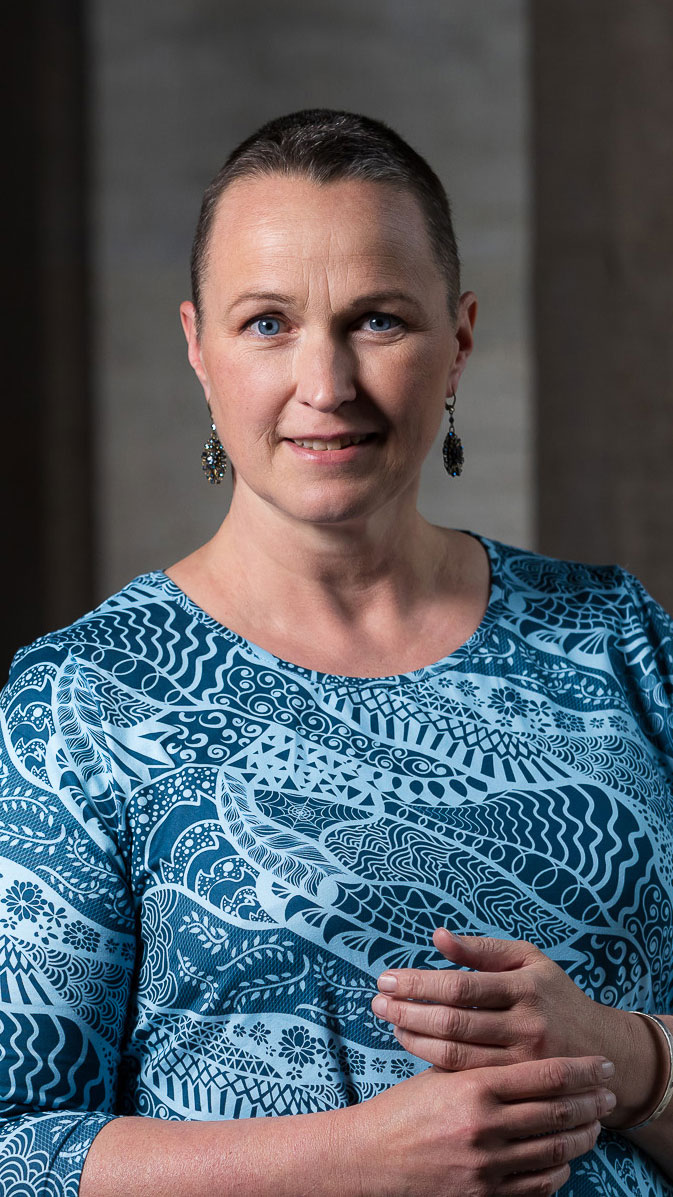
Jana Rogge is the founder of the PSI.Vision Institute, a graphic designer with a university degree in visual communication, a publisher, and a former lecturer at Bauhaus University Weimar, Germany. Since 2022, she has held a position as research director at MK Advisors (USA), where she is in charge of RV-based research and decision-making procedures in the domains of technological and strategic application. Focus topics include the theoretical and methodological issues surrounding remote viewing, the creation of application domains, training and practice quality assurance, scientific research, and the establishment and upkeep of global networks. She is president of the Center Lane Project (CLP), editor-in-chief of two English-language magazines on parapsychology and remote viewing, and board member of the Society for Anomalistics (GfA) and other international professional networks in parapsychology, anomalistics, and consciousness research.
Caren Gallaudet:
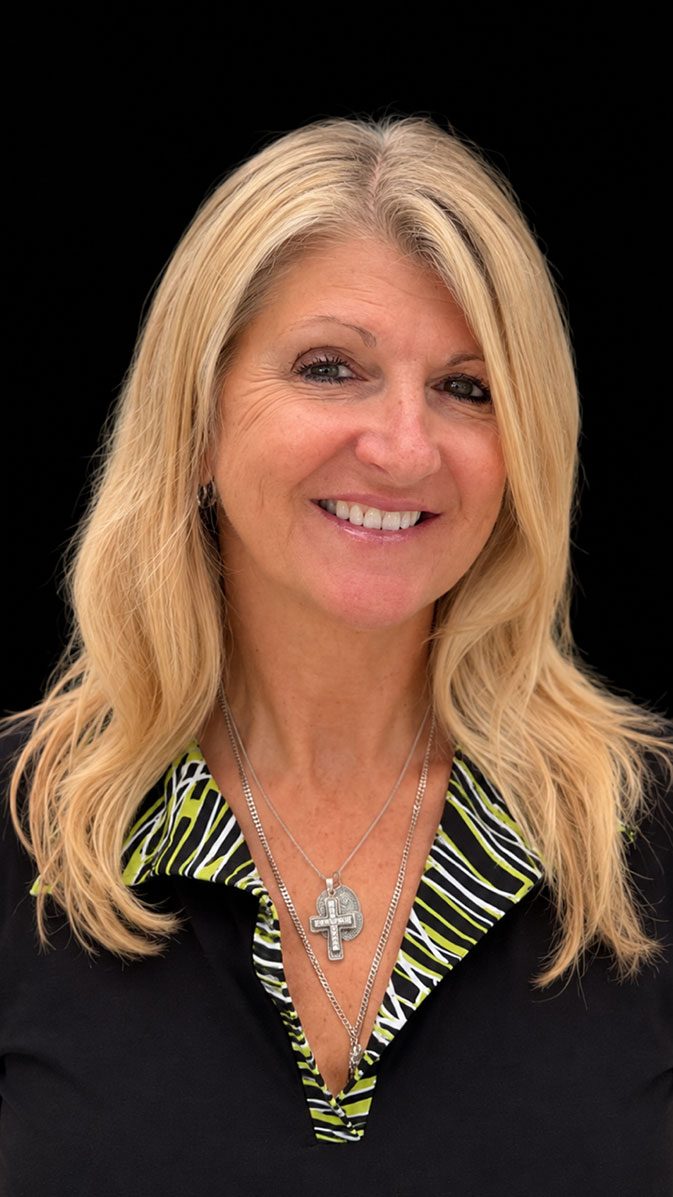
Caren Gallaudet is a US Naval Academy graduate who was trained as a hard hat Salvage Diver, and performed 2 deployments on the Mediterranean Sea in the 1990s on the USS Hoist and USS Grasp. Caren then earned a Master’s Degree in Underwater Acoustics and did research with the Marine Physical Laboratory and the US Navy using a passive drifting line array sonar in 2001. Caren and her husband Tim Gallaudet share a deep interest in UAP that began in 2017 and continues to this day, standing up as advocates for disclosure. In 2023, Caren decided to follow her growing interest in consciousness studies and train with Jana Rogge and Paul H. Smith in Controlled Remote Viewing (CRV).
Caren has become a close research collaborator with Jana Rogge, contributing her scientific rigor to experimental design, and serving as a co-experimenter on ongoing remote viewing studies, while also working as an operational remote viewer.
Estefany Carrillo:

Estefany Carrillo …
Operational Skill Training
The course fee (for 12 month of training)
will be $200 per month and person.
You will receive a monthly invoice for the duration of the course. If you decide to leave the group early, you will not be charged for the remainder of the time.
COURSE FORMAT AND APPLICATION
The BRIDGE’27 team mentoring starts in January 2027.
(Deadline for applications is November 30, 2026)
The program is designed as a one-year team process. It includes team building, regular meetings, role training, practical scenarios, and ongoing mentoring. The format brings together an ideal group size of 10 – 12 participants with support from three mentors.
Course format:
- 40 week of mentored group training (equals 3/4 weeks per month)
- weekly homeworks and assignments, aimed at building and practicing the different roles and skills
- explore every role and find out where your individual strengths and skills are to contribute to the team
- transition from practice environment to real client projects
Note: The training is limited to a maximum of 10 – 12 participants, which is the ideal size for an operational team.
Our long-term vision is to establish one new operational remote viewing team each year. This means your team will stay together after the training period to operate as an independent remote viewing group, while we provide ongoing mentoring on demand during the process of establishing your team in the market.
This is why we carefully select applicants for the team in the first place. The “human factor” plays a significant role in the process of building a team.
To apply for the course, email Caren (caren@psi-unit.com). Please provide a short overview of your previous experience and training in remote viewing, as well as any possible preferences for the roles that you’d like to explore for yourself.
Please note that we expect a high demand, so please don’t be disappointed if we can’t include everyone in one year. Our selection will be based on filling the different roles, experience of the participants, and other factors. We may ask you for a short introduction per Zoom in order to get to know you. The final decisions will be communicated shortly after the application deadline.


